Self-Serve Research Platforms vs Enterprise Sales: Why Transparency Wins
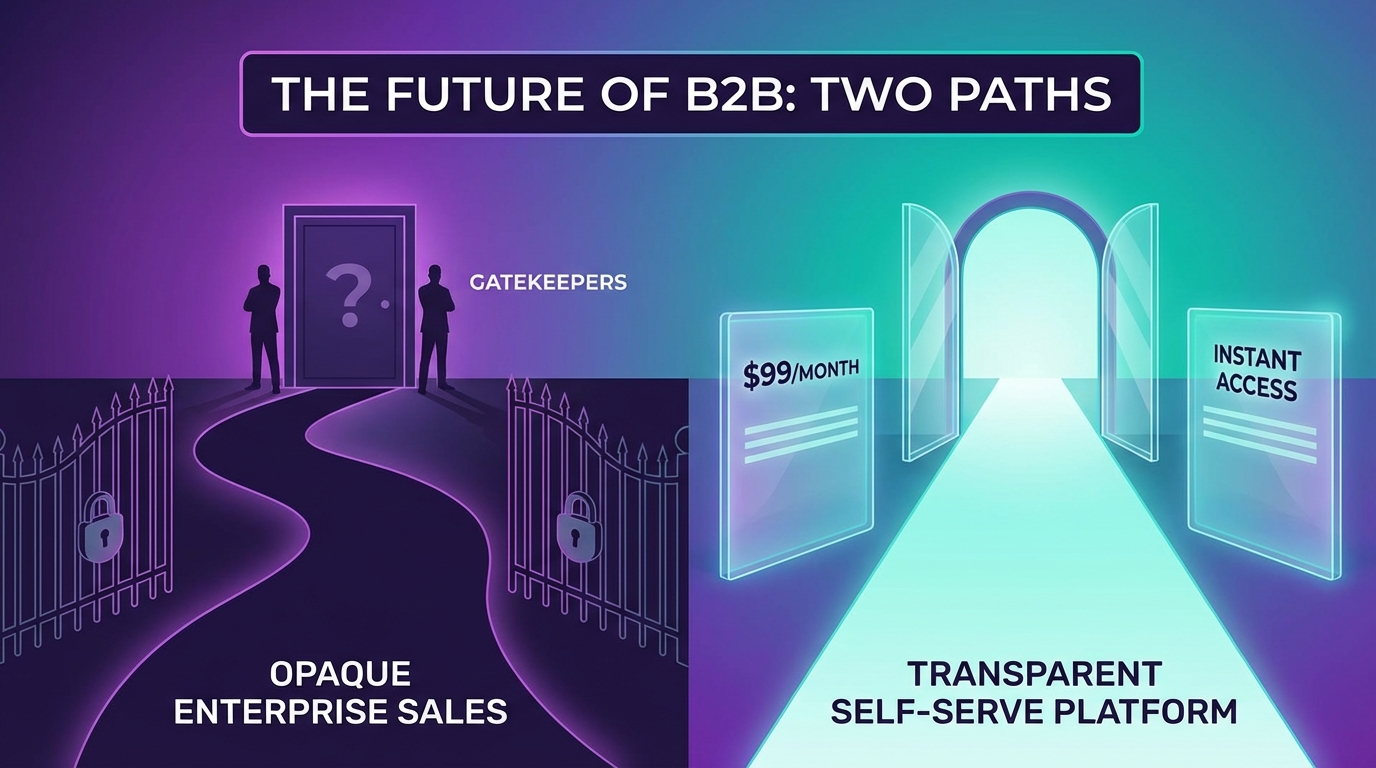
The research platform market is split between opaque enterprise-only tools and transparent self-serve platforms. Here's why transparency is winning.
Summary
The AI research platform market is experiencing a transparency revolution. While many leading platforms still hide behind enterprise-only sales models with opaque pricing and mandatory demo calls, a new generation of tools is proving that self-serve access with transparent pricing isn't just possible—it's preferable for most teams. This shift reflects a broader transformation in how modern research teams work: they need speed, predictability, and the ability to experiment without friction. This article examines why enterprise-only models create unnecessary barriers for researchers, how transparent self-serve platforms accelerate innovation, and why the future belongs to companies that respect their users' time and intelligence.
The Current State of AI Research Platform Pricing
If you've ever tried to buy an AI research platform, you know the drill. You land on a sleek website showcasing powerful features and impressive case studies. You're ready to get started. But instead of a "Start Free Trial" button or a pricing page, you see three dreaded words: "Contact Sales."
This is the reality for most AI research platforms today. The typical journey looks like this:
- Fill out a lengthy contact form
- Wait 24-48 hours for a sales response
- Schedule a discovery call (another week wait)
- Sit through a 60-minute demo of features you already researched
- Request pricing information
- Receive a "custom quote" that requires budget disclosure
- Navigate procurement, legal review, and contract negotiations
- Finally get access weeks or months after your initial interest
This enterprise-only model made sense in the early days of complex B2B software that required extensive customization. But in the era of cloud-native SaaS and self-service tools, it's increasingly anachronistic—especially for research platforms where speed and experimentation are paramount.
Why Enterprise-Only Models Persist
Many leading platforms continue this approach for several reasons:
Price discrimination: Without published pricing, sales teams can charge different amounts based on company size, budget signals, and negotiation skills. A Fortune 500 company might pay 10x what a startup pays for identical features.
Sales-driven culture: Traditional enterprise software companies built their entire business model around high-touch sales. Their organizational structure, compensation plans, and revenue forecasts depend on this model.
Complexity justification: Some platforms use complexity—real or manufactured—to justify the need for "consultative selling." If users can't figure out pricing, perhaps they can't figure out the product either.
Control and qualification: Enterprise sales processes allow vendors to qualify leads, prioritize high-value prospects, and maintain control over who accesses their platform.
The Friction Cost of Opacity
What does this enterprise-only approach actually cost researchers and their organizations?
Time to First Study
The most obvious cost is time. In a self-serve model, a researcher can sign up, configure their first study, and start collecting data within hours. In an enterprise model, that same process takes weeks or months.
For time-sensitive research—competitive analysis, rapid user feedback, product launch validation—this delay can be fatal. By the time contracts are signed and access is granted, the research question may be obsolete.
Organizational Bottlenecks
Enterprise sales processes create multiple bottlenecks:
- Procurement delays: Even after a sales agreement, many organizations require formal procurement processes, vendor onboarding, and security reviews.
- Budget cycles: Without knowing the price upfront, teams must wait for budget approval cycles, quarterly planning, or annual renewals.
- Stakeholder alignment: Opacity forces teams to involve more stakeholders earlier, turning a simple tool evaluation into a company-wide initiative.
Innovation Barriers
Perhaps the most damaging cost is to innovation itself. When researchers can't quickly experiment with new tools and methodologies, they default to what they already know. The friction of enterprise sales processes actively discourages exploration and learning.
A UX researcher who spots an interesting methodology can't just try it—they need to build a business case, get budget approval, and justify the investment before running a single study. This kills the experimental mindset that drives breakthrough insights.
The Self-Serve Advantage
Transparent self-serve platforms eliminate these barriers and create compounding advantages:
Speed to Value
With self-serve access, the journey is radically simplified:
- Browse pricing on the website
- Sign up with your email
- Start your first study immediately
- Upgrade when you need more capacity
This isn't just faster—it fundamentally changes the relationship between researcher and tool. Instead of a major procurement decision, trying a new research platform becomes as simple as trying a new productivity app.
Team Experimentation
Self-serve models enable bottom-up adoption. Individual researchers or small teams can start using a platform, prove its value with real results, and then expand usage across the organization.
This organic growth is more sustainable than top-down enterprise deployments, which often fail because the people who negotiated the contract aren't the people who use the tool daily.
Budget Predictability
Transparent pricing enables accurate budgeting. Research teams can plan their annual spending based on published rates and expected usage, rather than hoping their negotiated "custom quote" doesn't double at renewal time.
This predictability is especially valuable for lean teams and startups, where every dollar counts and budget surprises can be catastrophic.
Psychological Trust
There's a deeper benefit to transparency: trust. When a company publishes clear pricing, it signals confidence in its value proposition. It says, "Our product is good enough that we don't need to hide the price."
Opacity, conversely, signals mistrust. It tells potential customers, "We don't think you're capable of making this decision yourself" or "We're going to charge you as much as we think we can get away with."
In an era where buyers are more sophisticated and information is abundant, opacity increasingly backfires.
Comparing the Models
Here's how enterprise-only and self-serve models stack up across key dimensions:
| Dimension | Enterprise-Only | Self-Serve | Advantage |
|---|---|---|---|
| Time to first study | 2-8 weeks | Under 1 hour | Self-Serve |
| Pricing transparency | Hidden until late stages | Published on website | Self-Serve |
| Contract flexibility | Annual commitments | Monthly or usage-based | Self-Serve |
| Sales interaction | Required | Optional | Self-Serve |
| Customization | High-touch configuration | Standard + self-config | Enterprise |
| Support level | Dedicated account team | Self-service + paid support | Enterprise |
| Total cost predictability | Low (negotiation-dependent) | High (published rates) | Self-Serve |
| Barrier to trial | Very high | Very low | Self-Serve |
When Enterprise Still Makes Sense
To be clear: enterprise sales models aren't inherently wrong. They make sense for certain use cases:
True customization needs: When a customer requires genuine product customization, white-labeling, or integration work that goes beyond configuration, an enterprise sales process provides the framework for scoping and pricing that work.
Complex compliance requirements: Organizations in heavily regulated industries may need extensive security reviews or custom data processing agreements that require consultative selling.
Very large deployments: When a company plans to deploy a platform to thousands of users across multiple divisions and geographies, an account team can add significant value in planning and execution.
Strategic partnerships: Some relationships transcend simple vendor-customer dynamics and involve co-development, data sharing, or other strategic elements that benefit from high-touch engagement.
The key difference is whether the enterprise process is genuinely value-adding or simply friction-adding.
The Hybrid Model: Best of Both Worlds
The most customer-friendly approach combines transparent self-serve access with enterprise options for those who need them:
Tier Structure
A well-designed hybrid model might look like:
Self-Serve Tiers:
- Starter: Free or low-cost tier for individual researchers and small teams
- Professional: Mid-tier for growing teams with moderate usage
- Business: High-tier for established teams with substantial needs
Enterprise Tier:
- Custom pricing for organizations with unique requirements
- But still with published starting prices and transparent pricing methodology
Clear Upgrade Path
The key is making the upgrade path transparent. Even if your largest tier has "Contact Sales" for the final price, you should still publish:
- The base price or starting point
- What drives price variation (users, usage, features)
- What you get for the premium over self-serve tiers
This maintains transparency while acknowledging that some deals are genuinely complex.
How Transparency Builds Competitive Advantage
Companies leading with transparency aren't just being nice—they're building sustainable competitive advantages:
Lower Customer Acquisition Cost
Self-serve models dramatically reduce customer acquisition costs. Instead of expensive sales teams handling every lead, sales resources focus on high-value enterprise deals while the product itself converts self-serve customers.
Many successful self-serve companies report customer acquisition costs that are 5-10x lower than enterprise-only competitors.
Faster Iteration Cycles
When customers can sign up and start using your product immediately, you get feedback faster. This accelerates product development and allows you to iterate based on real usage patterns rather than sales promises.
Word-of-Mouth Growth
Researchers who can easily try a platform and see value quickly become advocates. They share their experiences with peers, write about their methodologies, and recommend tools that actually helped them.
This organic growth is more sustainable and credible than any amount of enterprise marketing.
Market Expansion
Transparent pricing opens markets that enterprise-only models can't reach: students, indie researchers, small agencies, international teams in regions without sales coverage, and anyone who values autonomy over handholding.
These customers might start small, but they represent enormous long-term growth potential.
The Competitive Landscape
The research platform market is beginning to bifurcate:
The Opaque Incumbents
Many leading platforms continue with enterprise-only models. Common patterns include:
- No pricing information on the website
- Required demo calls before access
- Custom quotes only
- Minimum contract values in the tens of thousands
- Annual commitments required
These platforms often serve Fortune 500 companies well but struggle to win emerging markets and alienate researchers who value speed and autonomy.
The Transparent Challengers
A new generation of platforms is competing on transparency:
- Clear pricing published on the website
- Free trials or freemium tiers
- Monthly or usage-based billing
- Self-service signup and onboarding
- Optional sales support for enterprise needs
These platforms are winning with agile research teams, startups, and individual researchers—and increasingly with enterprise teams who prefer to evaluate tools independently before involving procurement.
What Researchers Want
When you survey modern research teams about their ideal platform purchasing experience, consistent themes emerge:
Autonomy: Researchers want to evaluate tools on their own timeline, not a sales team's calendar. They're sophisticated professionals who can assess whether a platform meets their needs.
Speed: The competitive advantage of research insights comes from speed. Delays in tool adoption directly impact business value.
Predictability: Research budgets are often tight. Teams need to know what they're committing to and how costs will scale with usage.
Respect: Being forced through a sales process signals that a vendor doesn't trust users to make informed decisions. It feels patronizing.
Flexibility: Research needs change. Month-to-month or usage-based pricing aligns costs with actual value, rather than forcing teams to predict annual needs.
The Future Is Transparent
The trajectory is clear. Across the broader SaaS landscape, transparency is winning:
-
Developer tools: Nearly all modern developer platforms offer self-serve access with transparent pricing. Imagine if GitHub or Vercel required a sales call.
-
Marketing tools: Even sophisticated marketing platforms increasingly offer self-serve options alongside enterprise sales.
-
Data and analytics: Business intelligence platforms that once required six-figure enterprise deals now have self-serve tiers starting under $100/month.
Research platforms are following this same arc, just a few years behind. The platforms that recognize this shift early and lead with transparency will capture the growing market of research teams who value speed, autonomy, and respect.
How Synthesize Labs Leads on Transparency
At Synthesize Labs, transparency isn't just a marketing position—it's a core value that shapes product decisions:
Published pricing: Every tier, from free to enterprise, has clear pricing on the website. No hidden costs, no surprise fees.
Self-serve access: Anyone can sign up and start researching immediately. No demo calls required unless you want one.
Flexible commitments: Monthly billing means you only pay for what you use, when you use it. Scale up or down as needs change.
Enterprise add-ons: When you genuinely need enterprise features—SSO, custom contracts, dedicated support—they're available with transparent pricing and clear value.
Open methodology: We publish detailed documentation about our AI models, research methodologies, and data handling. Transparency extends beyond pricing to how the platform actually works.
This approach reflects our belief that researchers deserve better. You're sophisticated professionals who can evaluate tools, assess value, and make informed decisions. Our job is to build a great product and get out of your way.
Key Takeaways
-
Enterprise-only sales models create unnecessary friction for most research teams, adding weeks or months to the time-to-first-study and forcing researchers through bottlenecks that slow innovation.
-
Transparent self-serve platforms win on speed, predictability, and trust, enabling researchers to experiment quickly, budget accurately, and adopt tools bottom-up based on proven value.
-
Opacity signals mistrust and kills experimentation, while transparency demonstrates confidence in product value and respect for customers' decision-making ability.
-
The hybrid model is optimal for most platforms: Self-serve tiers for the majority of users, with transparent enterprise options for those with genuinely complex needs—not artificial complexity designed to justify sales processes.
-
The future of research platforms is transparent: Following the same trajectory as developer tools, marketing platforms, and analytics software, research platforms will increasingly compete on accessibility, clarity, and customer respect rather than sales process sophistication.
Synthesize Labs believes in transparent pricing and self-serve access. No sales calls required. See plans and start immediately. Learn more.
Related Articles
5 Market Research Trends Reshaping 2026
From AI-native research to synthetic participants, these five trends are fundamentally changing how organizations understand their customers in 2026.
From 6 Weeks to 48 Hours: Accelerating Your Research Cycle with AI
Traditional research takes 4-8 weeks. AI-powered interviews deliver executive-ready insights in under 48 hours. Here's how to make the transition.
Written by Synthesize Labs Team
Published on February 6, 2026