From 6 Weeks to 48 Hours: Accelerating Your Research Cycle with AI
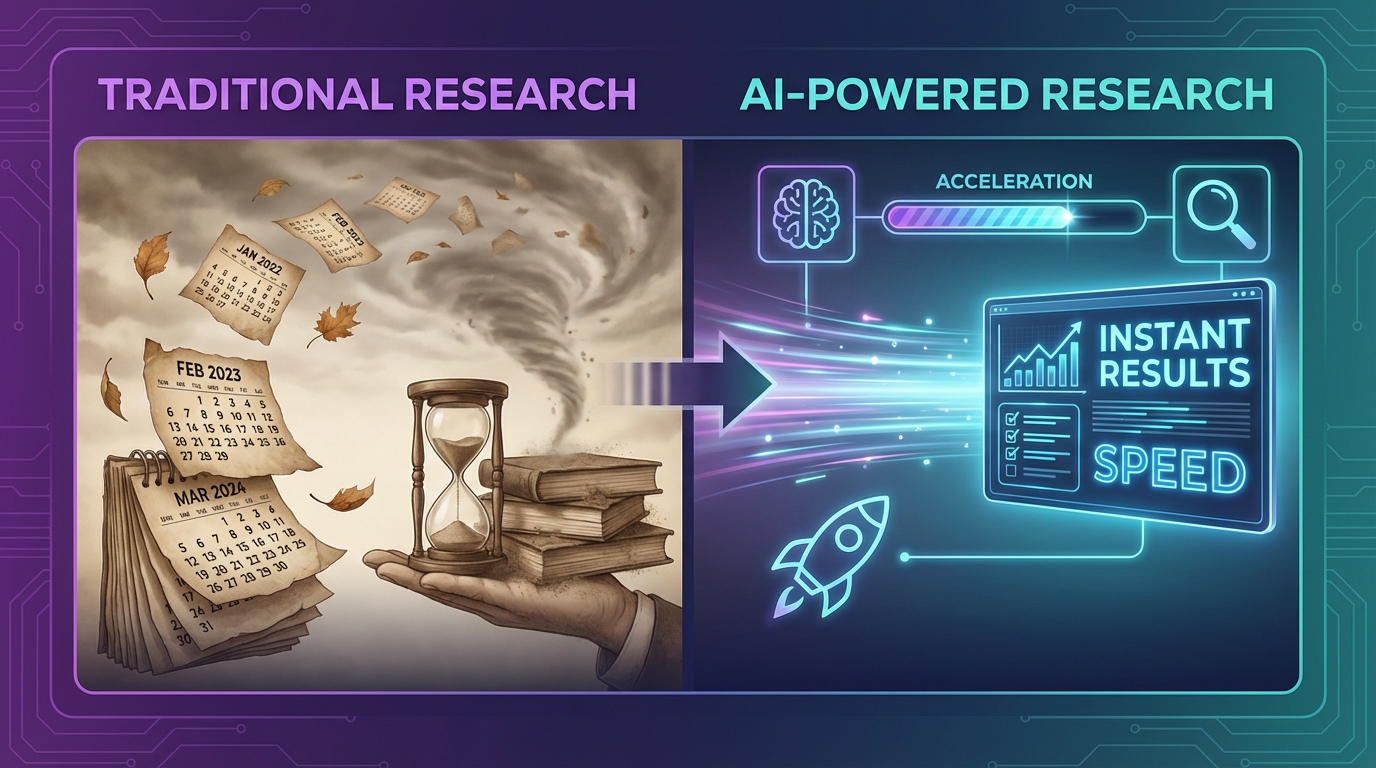
Traditional research takes 4-8 weeks. AI-powered interviews deliver executive-ready insights in under 48 hours. Here's how to make the transition.
Summary
The traditional user research timeline is fundamentally broken. What should take days stretches into weeks, turning agile product teams into bottlenecked decision-makers waiting for insights that arrive too late to matter. While development teams ship features in two-week sprints, research teams are still scheduling interviews from last quarter's roadmap.
This isn't a resource problem or a quality problem. It's an architecture problem. Traditional research was designed for an era when interviews required human moderators, transcription services, and manual analysis. AI fundamentally changes this architecture, eliminating the bottlenecks that slow research to a crawl.
This article breaks down exactly where traditional research loses time, how AI-powered interviewing collapses these delays from weeks to hours, and why faster research doesn't mean lower quality—it means better decisions when they actually matter.
The Traditional Research Timeline: A Week-by-Week Breakdown
Let's examine where a typical user research project actually spends its time. Understanding these delays is critical because AI doesn't just speed up research—it eliminates entire categories of work.
Week 1: Planning and Recruitment (5-7 days)
The traditional process begins with research design, screener creation, and recruitment coordination. Even with a dedicated recruiter or recruitment platform, this phase consumes at least a week:
- Days 1-2: Define research objectives, create discussion guide, write screener questions
- Days 3-4: Set up recruitment campaign, screen applicants, manage recruitment platform
- Days 5-7: Schedule interviews across participant calendars, send confirmations, handle no-shows
The coordination overhead here is massive. Every participant requires individual scheduling, email threads, calendar invitations, and reminder sequences. Even automated tools require manual review and quality control.
Week 2-3: Interviewing (7-10 days)
Traditional human-moderated interviews create inherent scheduling constraints:
- Limited daily capacity: Most researchers can conduct 3-4 quality interviews per day before fatigue degrades performance
- Calendar coordination: Matching participant availability with researcher availability creates gaps of days between sessions
- Geographic constraints: International research requires working across time zones, further limiting scheduling windows
- Interviewer variability: Different moderators ask questions differently, creating consistency challenges
A typical 15-participant study takes 4-6 days of actual interviewing, stretched across 7-10 calendar days due to scheduling gaps. Larger studies with 30-50 participants can take two full weeks or more.
Week 4-5: Transcription and Analysis (10-14 days)
After interviews complete, the real bottleneck begins:
- Days 1-3: Send recordings to transcription service, review transcripts for accuracy
- Days 4-8: Code transcripts, identify themes, build affinity maps
- Days 9-12: Synthesize findings, create insights presentation
- Days 13-14: Internal review, stakeholder alignment, presentation refinement
This analysis phase is where research becomes a bottleneck. By the time insights arrive, product decisions have often moved forward without them. Stakeholders who requested research weeks ago have made assumptions, picked directions, and committed to roadmaps.
Total Traditional Timeline: 4-6 Weeks Minimum
| Phase | Traditional Timeline | Key Bottlenecks |
|---|---|---|
| Planning and Recruitment | 5-7 days | Manual screening, calendar coordination |
| Interviewing | 7-10 days | Human moderator capacity, scheduling constraints |
| Transcription | 2-3 days | Third-party services, quality review |
| Analysis and Synthesis | 10-14 days | Manual coding, theme identification, report creation |
| Total | 24-34 days | Sequential dependencies, human capacity limits |
This timeline assumes everything goes smoothly. In reality, participant no-shows, scheduling conflicts, and stakeholder review cycles often extend projects beyond six weeks.
Where AI Eliminates Research Bottlenecks
AI-powered research doesn't just automate tasks—it fundamentally restructures the research workflow by eliminating the constraints that create delays. Here's how each bottleneck collapses:
Recruitment: From Days to Hours
Traditional recruitment requires manual screening because humans need to verify that participants match your criteria. AI interviewing removes this bottleneck entirely:
- Automated qualification: AI interviewers can screen participants during the conversation itself, ensuring quality without pre-interview coordination
- No scheduling overhead: Participants complete interviews on their own schedule via asynchronous links
- Instant capacity scaling: Whether you need 10 or 100 participants, AI capacity is unlimited
What previously took 5-7 days of coordination now happens in hours. Share a link, and participants begin interviewing themselves.
Interviewing: From Weeks to Days
The human moderator is the single biggest capacity constraint in traditional research. AI removes this limitation completely:
- Unlimited parallel capacity: 50 participants can interview simultaneously instead of waiting for sequential scheduling
- 24/7 availability: Participants in any timezone can complete interviews immediately
- Perfect consistency: Every participant receives identical question delivery, eliminating moderator variability
- Adaptive follow-up: AI can probe interesting responses in real-time while maintaining consistency across sessions
A study that previously required 10 days of sequential interviewing now completes in 24-48 hours of parallel data collection.
Transcription: From Days to Instant
Traditional transcription introduces a 2-3 day delay while third-party services process recordings. AI interviews are transcribed in real-time as the conversation occurs. The moment an interview completes, the full transcript is immediately available for analysis.
Analysis: From Weeks to Hours
This is where AI creates the most dramatic acceleration. Traditional analysis requires:
- Reading every transcript completely
- Manually coding responses into themes
- Building affinity maps to identify patterns
- Writing narrative summaries of findings
AI analysis completes this entire workflow in minutes:
- Instant theme identification: AI analyzes all transcripts simultaneously, identifying patterns across the full dataset
- Automated synthesis: Findings are automatically organized into executive summaries, detailed insights, and supporting quotes
- Interactive exploration: Instead of waiting for a static report, stakeholders can query findings directly
What previously took 10-14 days of analyst work now happens automatically as interviews complete.
The New Research Timeline: Under 48 Hours
| Phase | AI-Powered Timeline | How AI Accelerates |
|---|---|---|
| Planning and Setup | 2-4 hours | Create interview guide, configure AI interviewer |
| Recruitment and Interviewing | 24-48 hours | Participants self-schedule via async link, unlimited parallel capacity |
| Transcription | Real-time | Automatic as interviews occur |
| Analysis and Synthesis | 1-2 hours | Automated theme identification, instant synthesis |
| Total | Under 48 hours | Parallel execution, automated analysis |
This isn't a theoretical timeline. This is how fast research actually runs when bottlenecks are eliminated.
Real-World Examples: Research Sprints in Action
Product Launch Validation: 48-Hour Turnaround
A B2B SaaS company needed to validate messaging for a new enterprise feature before their annual user conference. Traditional research would have taken 4-6 weeks—far too slow for a launch deadline three weeks away.
Using AI-powered interviewing:
- Day 1 morning: Research team created interview guide focused on messaging comprehension and value proposition resonance
- Day 1 afternoon: Shared interview link with 40 enterprise customers via email
- Day 2: 35 interviews completed overnight as customers participated on their own schedules
- Day 2 evening: AI analysis identified three key messaging issues and provided verbatim quotes showing customer confusion
- Day 3: Product marketing revised messaging based on insights, re-tested with 15 additional customers same-day
Total time from research kickoff to validated new messaging: 48 hours. The launch went forward with confidence instead of assumptions.
Continuous Discovery: Weekly Research Cycles
A mobile app startup integrated AI interviewing into their weekly sprint rhythm. Every Monday, they deploy interview links to recent users. By Wednesday, they have synthesis ready for sprint planning.
This cadence was impossible with traditional research:
- Volume: 20-30 interviews per week would require full-time recruitment and moderation staff
- Speed: Traditional analysis couldn't deliver insights within the same week
- Cost: Weekly human-moderated research would cost tens of thousands per month
With AI interviewing, weekly research costs less than a single traditional study and delivers insights when product teams actually make decisions.
International Expansion: Multi-Market Research in Days
A consumer product company needed to validate product-market fit across six countries before committing expansion budget. Traditional research quoted 8-10 weeks and significant cost for international recruitment and translation.
AI-powered approach:
- Day 1: Created interview guide, configured AI interviewer in six languages
- Days 2-3: Recruited participants via social ads in each market
- Days 3-5: 300 interviews completed across all markets
- Day 6: Cross-market analysis identified which markets showed strongest product-market fit
Total timeline: 6 days. Traditional research would have taken two months and delivered insights too late for the quarterly planning cycle.
Integrating Rapid Research Into Product Development
The value of fast research isn't just speed—it's the ability to integrate insights directly into decision-making workflows. Here's how leading teams are restructuring their processes:
Research-Driven Sprint Planning
Instead of quarterly research projects that inform high-level strategy, teams now run research during sprints:
- Sprint kickoff: Identify open questions about user needs, feature priorities, or experience issues
- Days 1-2: Deploy AI interviews to relevant user segments
- Days 3-4: Review synthesis during mid-sprint checkpoint
- Days 5-10: Build with validated insights instead of assumptions
This rhythm transforms research from an external input to an integrated workflow.
Continuous Validation Loops
Fast research enables validation loops that were previously impossible:
- Pre-development: Validate problem severity and solution direction before building
- Design validation: Test prototypes and mockups with real users during design phase
- Post-launch: Gather feedback within days of shipping to catch issues before they compound
Stakeholder Alignment Through Data
When research takes weeks, stakeholder debates continue without resolution while everyone waits for data. Fast research changes this dynamic:
- Settle debates quickly: Deploy research to answer contested questions within 48 hours
- Reduce HiPPO decisions: Executives can request research and receive answers in the same week
- Build evidence-based culture: When insights arrive fast enough to matter, teams learn to ask for data instead of relying on intuition
Addressing the Speed vs. Quality Concern
The most common objection to fast research is that it must sacrifice quality. This assumes that slow research is inherently more rigorous. In reality, the relationship between speed and quality is more nuanced.
Where Traditional Research Actually Loses Quality
Traditional research introduces quality issues that AI research avoids:
Moderator variability: Different interviewers ask questions differently, probe inconsistently, and inject personal biases. AI delivers identical question delivery across all sessions.
Small sample sizes: When each interview requires expensive moderation time, studies default to 10-15 participants for budget reasons. AI enables 50-100+ participant studies at similar cost.
Confirmation bias in analysis: Human analysts often identify themes that confirm existing hypotheses. AI analysis surfaces unexpected patterns that human reviewers might miss.
Recency bias: Traditional analysis takes so long that early interviews fade from memory. AI analyzes all transcripts simultaneously without recency effects.
Where AI Maintains Research Rigor
Quality research requires:
- Appropriate sampling: Recruiting participants who match target user criteria
- Consistent questioning: Asking all participants comparable questions
- Thorough probing: Following up on interesting or ambiguous responses
- Comprehensive analysis: Identifying patterns across the full dataset
AI research delivers all four requirements:
- Sampling: Recruitment targeting works identically whether interviews are human or AI moderated
- Consistency: AI asks questions exactly as written, without variation
- Probing: AI can be configured to follow up on specific topics or responses
- Analysis: AI analyzes 100% of responses, not a manually coded subset
The Real Quality Question: Depth vs. Breadth
The valid quality debate isn't whether AI research is rigorous—it's whether breadth research (many shorter AI interviews) provides comparable insights to depth research (fewer longer human interviews).
The answer depends on research goals:
Depth research excels at: Exploring complex motivations, building empathy through storytelling, uncovering unexpected mental models
Breadth research excels at: Validating patterns across populations, measuring prevalence of behaviors, identifying segmentation differences
Most product research needs breadth more than depth. Teams need to know whether a problem affects 10% or 80% of users, which segments care about which features, and whether messaging resonates broadly. This is exactly what AI research delivers better than traditional methods.
For the minority of projects requiring deep exploration, combine both approaches: use AI breadth research to identify patterns, then conduct targeted human depth interviews with interesting segments.
Making the Transition: Practical Steps
Moving from traditional to AI-powered research doesn't require abandoning existing practices overnight. Here's a practical transition path:
Start With High-Volume, Low-Complexity Studies
The easiest place to begin is research that traditionally suffers most from bottlenecks:
- Feature prioritization surveys: Which capabilities matter most to which segments
- Message testing: How do users interpret product positioning and value propositions
- Usability feedback: What friction points exist in current experiences
These studies require breadth more than depth and deliver immediate time savings.
Run Parallel Validation Studies
Build confidence by running identical studies with both traditional and AI methods:
- Compare timelines: Measure actual days to insights
- Compare findings: Validate that AI research surfaces similar themes
- Compare costs: Calculate total investment including internal time
Most teams find that AI research delivers comparable insights in a fraction of the time and cost.
Integrate Into Existing Workflows
Rather than creating new processes, embed AI research into existing decision points:
- Sprint planning: Add research as a standard pre-sprint input
- Quarterly planning: Run AI research to validate assumptions before committing roadmap
- Launch readiness: Make user validation a launch checklist requirement
Build Research Literacy Across Teams
When research is fast and accessible, non-researchers can use it effectively. Invest in training:
- Interview guide creation: Help PMs and designers write effective questions
- Synthesis interpretation: Teach teams to read and apply insights
- Research ethics: Ensure all users understand participant privacy and consent
Democratizing research access requires democratizing research skills.
Key Takeaways
-
Traditional research timelines are structurally slow: The 4-6 week research cycle isn't a resource problem—it's created by sequential dependencies and human capacity constraints that AI fundamentally eliminates.
-
AI collapses bottlenecks through parallelization: Unlimited interviewer capacity, 24/7 availability, and automated analysis transform research from a sequential process to a parallel one, delivering insights in under 48 hours.
-
Speed enables new research workflows: Fast research isn't just traditional research done faster—it enables continuous validation loops, sprint-integrated insights, and data-driven debate resolution that were previously impossible.
-
Quality concerns conflate depth with rigor: AI research maintains methodological rigor through consistent questioning, comprehensive analysis, and larger sample sizes. The tradeoff is depth vs. breadth, not quality vs. speed.
-
Transition gradually by targeting bottleneck studies first: Start with high-volume research that suffers most from traditional delays, validate AI findings against traditional methods, then expand to sprint-integrated continuous research.
Synthesize Labs delivers executive-ready research insights in hours, not weeks. Learn more.
Related Articles
5 Market Research Trends Reshaping 2026
From AI-native research to synthetic participants, these five trends are fundamentally changing how organizations understand their customers in 2026.
Self-Serve Research Platforms vs Enterprise Sales: Why Transparency Wins
The research platform market is split between opaque enterprise-only tools and transparent self-serve platforms. Here's why transparency is winning.
Written by Synthesize Labs Team
Published on July 25, 2025