Qual at Quant Scale: How AI Interviews Bridge the Research Gap
AI-powered interviews combine the depth of qualitative research with the scale of quantitative studies. Learn how this changes the research landscape.
Summary
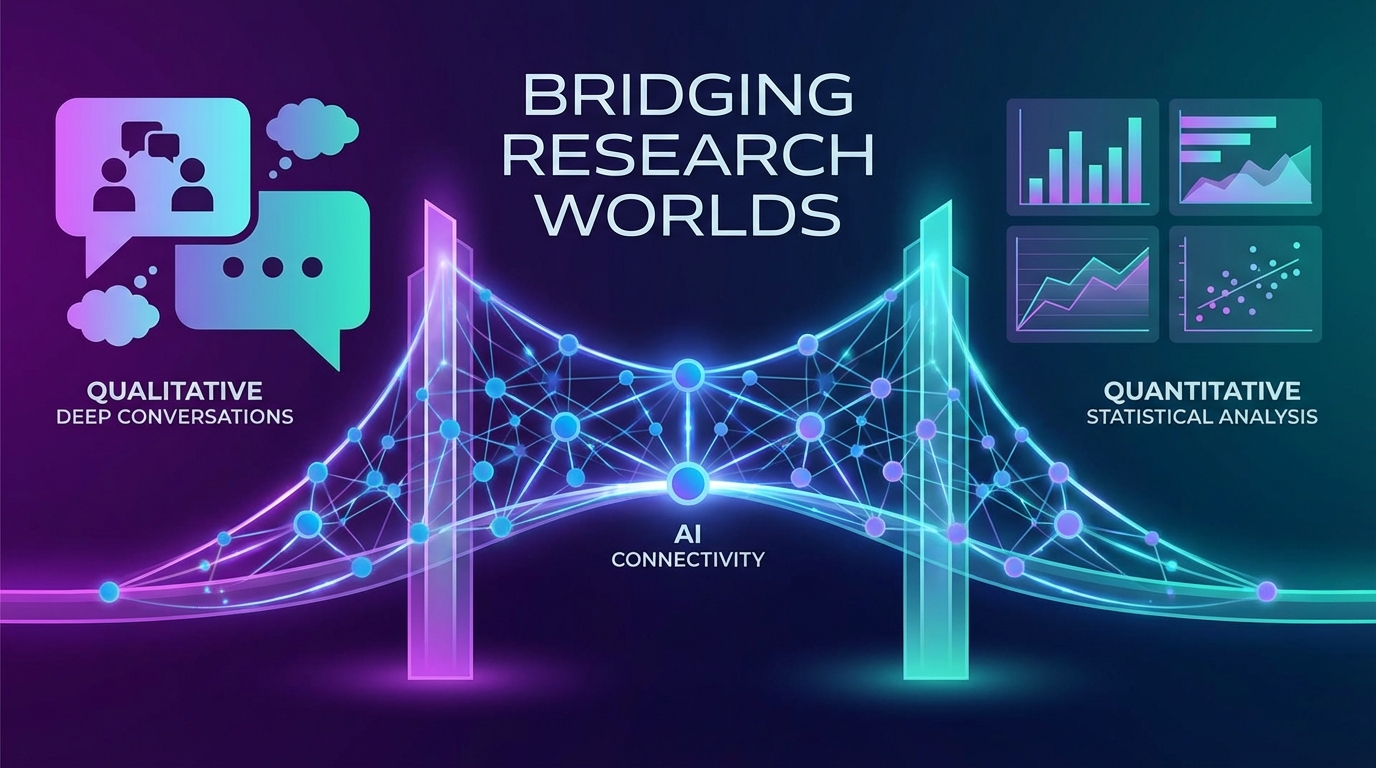
For decades, researchers faced an unavoidable tradeoff: choose depth or scale, but never both. Qualitative methods like interviews provided rich insights but were limited to dozens of participants. Quantitative surveys reached thousands but missed the nuance and context that drive true understanding. AI-powered interviews eliminate this constraint, enabling researchers to conduct thousands of in-depth conversations simultaneously while maintaining the exploratory nature of qualitative research and the statistical power of quantitative analysis.
This article examines how AI interviews bridge the traditional research gap, what "qual at quant scale" looks like in practice, and when researchers should still rely on conventional methods. We explore real-world applications, implementation strategies, and the paradigm shift this technology represents for research design.
The Traditional Research Tradeoff
Qualitative Research: Deep but Narrow
Qualitative methods excel at uncovering the "why" behind human behavior. In-depth interviews, focus groups, and ethnographic studies reveal motivations, emotions, and contextual factors that surveys cannot capture. A skilled interviewer adapts questions in real-time, probes interesting responses, and builds rapport that encourages authentic disclosure.
The limitation? Scale. Conducting, transcribing, and analyzing even 50 in-depth interviews requires months of work. Most qualitative studies involve 15-30 participants due to resource constraints. This narrow sample size limits generalizability and makes it difficult to identify patterns across diverse populations.
Quantitative Research: Broad but Shallow
Quantitative methods provide statistical power and generalizability. Surveys can reach thousands or millions of participants, enabling researchers to identify trends, test hypotheses, and make predictions with measurable confidence intervals. The structured format ensures consistency and comparability across responses.
The drawback? Depth. Pre-determined questions cannot explore unexpected insights. Multiple choice options force participants into categories that may not reflect their true experience. There is no opportunity to probe, clarify, or understand the reasoning behind a response. Researchers must know what to ask before the study begins.
The Gap in the Middle
This tradeoff creates a significant gap in research capability. Many research questions require both depth and scale:
- Product development: Understanding why hundreds of customers abandon a checkout flow requires both the pattern recognition of quantitative data and the contextual insights of qualitative research.
- Policy research: Evaluating a new healthcare policy demands statistical validation across thousands of citizens while understanding individual experiences and concerns.
- Academic research: Testing theoretical frameworks requires large sample sizes for statistical power, but theory development depends on deep exploration of individual cases.
Researchers have attempted to bridge this gap through mixed methods approaches, but these still require choosing where to allocate limited resources. Until now.
How AI Eliminates the Tradeoff
Conversational AI at Scale
Modern AI systems can conduct genuinely conversational interviews that adapt to participant responses, probe for deeper insights, and maintain context throughout extended discussions. Unlike static surveys, these AI interviewers ask follow-up questions, request clarification, and explore unexpected topics that emerge during conversation.
The breakthrough is scalability. While a human researcher might conduct 5-10 interviews per week, an AI system can conduct thousands simultaneously. Each conversation maintains the depth and adaptability of qualitative research while achieving the sample sizes of quantitative studies.
Maintaining Qualitative Depth
AI interviews preserve key elements of qualitative research methodology:
Adaptive questioning: The AI adjusts questions based on previous responses, following interesting threads and skipping irrelevant topics.
Open-ended exploration: Participants respond in their own words without being constrained by predetermined options.
Contextual understanding: The AI maintains conversation context, referring back to earlier points and building on participant narratives.
Rapport building: Natural language processing enables conversational flow that feels less transactional than traditional surveys.
Achieving Quantitative Scale
Simultaneously, AI interviews provide quantitative advantages:
Large sample sizes: Conduct 1,000 or 10,000 interviews as easily as 100, enabling statistical analysis and subgroup comparisons.
Rapid deployment: Launch studies in hours rather than weeks, and complete data collection in days rather than months.
Cost efficiency: Per-interview costs drop dramatically as scale increases, making large qualitative studies economically feasible.
Consistent execution: Every participant receives the same quality of interview experience without researcher fatigue or bias variation.
Qual at Quant Scale in Practice
What 1,000 Deep Interviews Looks Like
Consider a product research study exploring why users abandon a mobile app:
Traditional qualitative approach: 20 in-depth interviews over 4 weeks. Rich insights into specific pain points, but limited ability to identify which issues are widespread versus edge cases.
Traditional quantitative approach: 5,000 survey responses in 1 week. Clear statistics on abandonment rates by demographic, but no understanding of underlying motivations.
AI hybrid approach: 1,000 conversational interviews over 3 days. Each 20-minute conversation explores:
- Initial expectations when downloading the app
- Specific moments of friction or confusion
- Comparison to competing products
- Decision-making process leading to abandonment
- Suggestions for improvement
The result? Statistical power to identify that 67% of users abandon due to onboarding complexity, combined with hundreds of detailed narratives explaining exactly where and why onboarding fails. Pattern recognition reveals three distinct user archetypes, each with different pain points. And verbatim quotes illustrate each finding with authentic user voice.
Thematic Analysis Across Massive Datasets
Analyzing thousands of qualitative interviews was previously impossible using traditional manual coding methods. AI changes this through automated thematic analysis:
Pattern identification: Natural language processing identifies recurring themes, concepts, and sentiment patterns across thousands of transcripts.
Hierarchical coding: Automated systems generate initial coding frameworks that human researchers can refine and validate.
Quote extraction: Search and filter thousands of responses to find representative quotes for specific themes.
Subgroup analysis: Compare themes across demographic groups, user segments, or experimental conditions with statistical significance.
Longitudinal tracking: Monitor theme evolution across multiple study waves to track changing attitudes over time.
This computational approach does not replace human insight. Researchers still interpret findings, develop theoretical frameworks, and make strategic recommendations. But AI handles the mechanical work of processing thousands of transcripts, freeing researchers to focus on higher-order analysis.
Comparing Research Approaches
| Dimension | Traditional Qualitative | Traditional Quantitative | AI Hybrid Approach |
|---|---|---|---|
| Sample Size | 15-50 participants | 500-10,000+ participants | 500-10,000+ participants |
| Response Depth | Very high (open narrative) | Low (fixed options) | High (conversational) |
| Data Collection Time | 4-12 weeks | 1-4 weeks | 1-7 days |
| Cost per Participant | High ($100-500) | Low ($1-10) | Medium ($10-50) |
| Adaptability | Very high (custom questions) | None (fixed questions) | High (dynamic questions) |
| Statistical Power | None | Very high | High |
| Generalizability | Low | High | High |
| Contextual Understanding | Very high | Low | Medium-High |
| Researcher Time Required | Very high | Low | Medium |
Practical Implementation Strategies
Designing AI Interview Protocols
Effective AI interviews require careful protocol design:
Define core objectives: Identify the key research questions and required depth of exploration for each topic.
Create conversation guides: Develop flexible question frameworks rather than rigid scripts, allowing the AI to adapt while maintaining focus.
Build in probing logic: Define when and how the AI should probe deeper, request examples, or explore contradictions.
Set conversation boundaries: Establish appropriate scope to balance comprehensiveness with participant fatigue (typically 15-30 minutes).
Plan for unexpected insights: Design protocols that allow participants to raise topics you had not anticipated.
Quality Assurance
Maintaining quality at scale requires systematic validation:
Pilot testing: Conduct initial rounds with smaller samples to refine protocols before full deployment.
Transcript review: Sample and review raw transcripts to ensure conversation quality and appropriate probing.
Participant feedback: Collect experience ratings to identify issues with flow, clarity, or technical problems.
Comparative validation: Run parallel studies with traditional methods on subsamples to validate findings.
Ongoing monitoring: Track metrics like completion rates, conversation length, and response quality throughout data collection.
Integration with Traditional Methods
AI interviews work best as part of a comprehensive research strategy:
Sequential integration: Use AI interviews for initial exploration and hypothesis generation, then validate key findings with targeted traditional qualitative or quantitative follow-up.
Parallel triangulation: Conduct AI interviews alongside traditional methods to cross-validate findings and identify method-specific insights.
Iterative refinement: Start with small-scale traditional qualitative research to develop interview protocols, then scale with AI.
When to Use Traditional Methods
AI interviews are powerful but not universally appropriate. Traditional methods remain essential in several scenarios:
When Traditional Qualitative is Better
Sensitive or traumatic topics: Human interviewers build trust and provide emotional support that AI cannot match when discussing deeply personal experiences.
Complex visual or physical contexts: Ethnographic research requiring observation of physical spaces, body language, or material artifacts needs human presence.
Theoretical development: Grounded theory development and complex theoretical frameworks often benefit from the intuitive leaps human researchers make during data collection.
Cultural specificity: Research in cultures with limited digital literacy or strong preferences for human interaction may achieve better participation and data quality with human interviewers.
When Traditional Quantitative is Better
Simple behavioral tracking: When you only need to measure specific behaviors or attitudes without understanding context, traditional surveys remain more cost-effective.
Experimental control: Tightly controlled experiments requiring precise manipulation checks and attention verification benefit from structured survey formats.
Longitudinal panel studies: Long-term tracking of the same individuals over months or years may create participant fatigue with repeated conversational interviews.
Extremely large scale: Population-level studies reaching hundreds of thousands or millions may still require traditional survey methods for maximum reach and minimal cost.
Case Studies: Hybrid Approaches in Action
Healthcare Experience Research
A hospital network sought to understand patient experiences across 50 locations with diverse patient populations. Traditional approaches would require either broad surveys losing contextual detail or small-scale interviews lacking generalizability.
Hybrid implementation: 3,000 AI interviews (20 minutes each) with recent patients, exploring:
- Journey from symptom onset through treatment
- Communication quality with providers
- Moments of confusion or anxiety
- Comparison to expectations
- Suggestions for improvement
Outcomes: Statistical identification that 58% of patients experienced communication gaps during care transitions. Thematic analysis revealed distinct patterns by care setting. Verbatim narratives enabled staff training materials featuring authentic patient voices. Subgroup analysis identified specific needs of non-English speaking patients that surveys had missed.
Software User Experience
A SaaS company redesigning its enterprise product needed to understand why feature adoption varied dramatically across customer organizations.
Hybrid implementation: 1,200 AI interviews with users across different roles, company sizes, and adoption levels. Conversations explored workflow context, decision-making processes, and organizational barriers.
Outcomes: Discovered that adoption challenges were not about feature usability but organizational change management. Identified three distinct implementation patterns corresponding to company culture types. Generated quantitative data on barrier prevalence while capturing rich narratives for case study development. Informed both product redesign and customer success strategies.
Academic Social Science Research
Researchers studying financial decision-making needed to test theoretical frameworks requiring both large sample sizes and deep exploration of reasoning processes.
Hybrid implementation: 800 AI interviews exploring how individuals made recent major financial decisions. Each conversation traced decision chronology, information sources, emotional factors, and outcome evaluation.
Outcomes: Sufficient statistical power to test theory predictions across demographic groups. Qualitative depth to refine theoretical constructs and identify unexpected decision factors. Efficient data collection enabling multiple study waves to test intervention effects. Publication in peer-reviewed journals with both quantitative findings and qualitative evidence.
The Future of Research Design
AI interviews represent a paradigm shift in research methodology, but we are only beginning to explore the implications:
Continuous research: Organizations can maintain ongoing conversations with stakeholders rather than conducting periodic one-time studies.
Personalized inquiry: AI can tailor questions to individual contexts, asking different things of different participants while maintaining comparable data.
Multilingual research: Automatic translation enables truly global studies without language barriers.
Multimodal integration: Combining conversational interviews with behavioral data, physiological measures, or visual analysis creates comprehensive understanding.
Real-time adaptation: Studies can adjust focus mid-collection as patterns emerge, following interesting threads without waiting for analysis.
The traditional qual versus quant distinction may become obsolete. Future research will routinely combine depth and scale, generating insights impossible under previous constraints.
Key Takeaways
-
The traditional research tradeoff between depth and scale is being eliminated by AI-powered interviews that provide qualitative richness at quantitative scale, enabling studies with thousands of in-depth conversations.
-
AI interviews maintain core qualitative principles including adaptive questioning, open-ended exploration, and contextual understanding while achieving the sample sizes, statistical power, and rapid deployment of quantitative methods.
-
Thematic analysis of massive interview datasets is now computationally feasible, enabling pattern identification, automated coding, and subgroup analysis across thousands of transcripts while preserving researcher interpretation and insight.
-
Traditional methods remain essential for sensitive topics requiring human empathy, contexts demanding physical presence, purely behavioral tracking, and extremely large-scale population studies.
-
Effective implementation requires careful protocol design, systematic quality assurance, and strategic integration with traditional methods rather than treating AI interviews as a complete replacement for existing approaches.
Synthesize Labs delivers qualitative depth at quantitative scale. Run thousands of in-depth interviews simultaneously. Learn more.
Related Articles
Why AI Interviews Get 3x Deeper Responses Than Human Moderators
Research shows AI-moderated interviews produce significantly longer, more candid responses. Learn why participants open up more to AI and what it means for your research.
Running Global Research in 100+ Languages Without Translation Agencies
Conduct AI-powered interviews in any language and get synthesized results instantly. Learn how multilingual AI research eliminates translation bottlenecks.
Chat With Your Data: Using RAG to Query Interview Transcripts
Ask follow-up questions across thousands of interviews instantly. Learn how retrieval-augmented generation transforms research data into a searchable knowledge base.
Written by Synthesize Labs Team
Published on December 5, 2025