Security Architecture Deep Dive: SOC 2 Type II, HIPAA, and GDPR Certified Infrastructure
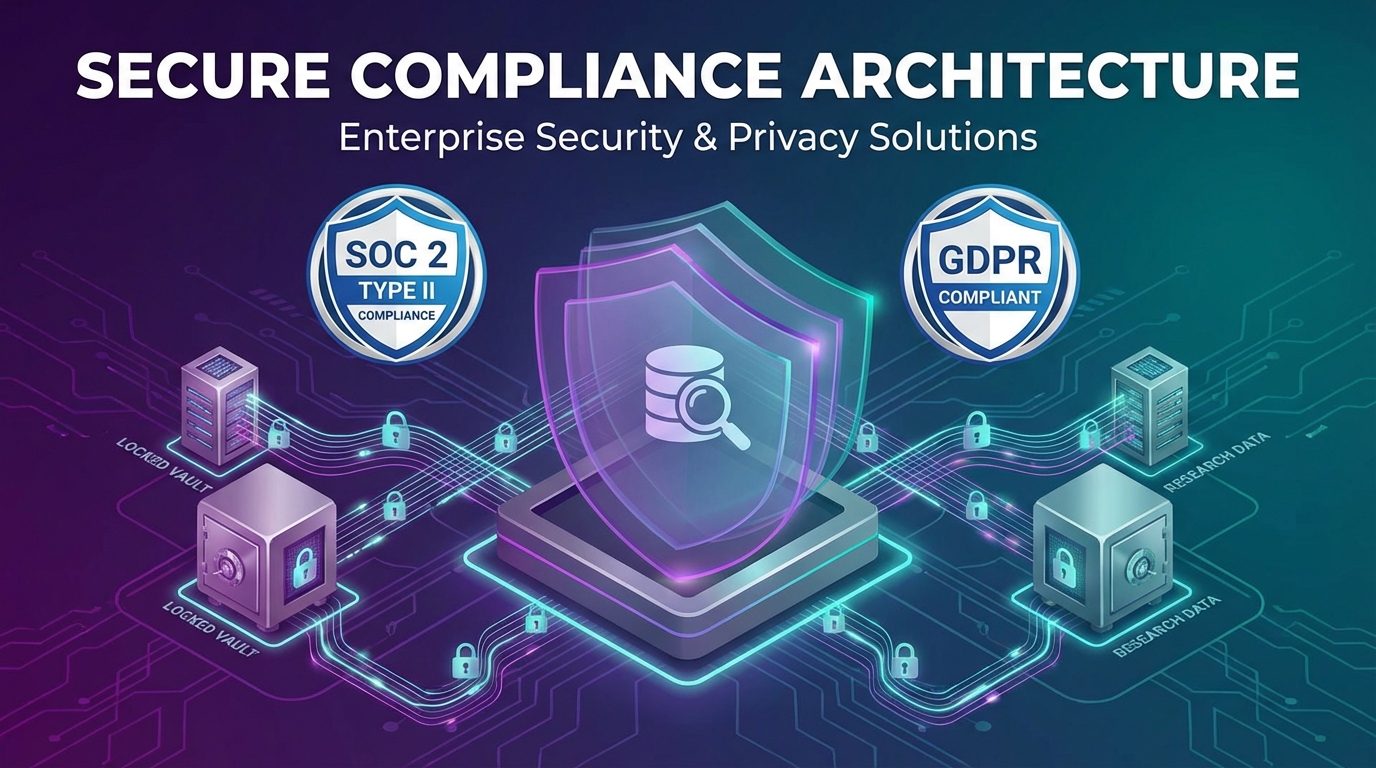
Your data is processed through and rests securely in data centers that maintain SOC 2 Type II, HIPAA, and GDPR certifications.
Summary
Research data represents some of the most sensitive information organizations handle. From confidential business strategies to proprietary methodologies, research platforms process information that cannot be compromised, leaked, or misused. At Synthesize Labs, we built our application on infrastructure providers that maintain rigorous security certifications, and we implement security best practices at every layer of our application.
Your data is processed through and rests securely in data centers that maintain SOC 2 Type II, HIPAA, and GDPR certifications. This deep dive explores the infrastructure certifications we rely on, the application-level security controls we implement, and the architectural decisions that enable organizations in healthcare, finance, and other regulated sectors to confidently use AI for research.
Why Research Data Requires Exceptional Security
Research data sits at the intersection of intellectual property, strategic planning, and often personal information. A single research project might contain:
- Proprietary methodologies that represent years of competitive advantage
- Confidential participant data protected by ethics boards and regulations
- Strategic insights that could impact market position if exposed
- Third-party information covered by NDAs and contractual obligations
- Personal health information subject to HIPAA or similar regulations
Traditional cloud applications often use customer data to improve their models or services. For research platforms, this is unacceptable. Research organizations need absolute certainty that their data remains isolated, encrypted, and never used for purposes beyond their explicit control.
The Stakes for Regulated Industries
Healthcare and financial services organizations face additional pressures. A data breach doesn't just mean reputational damage; it can result in:
- Regulatory fines reaching millions of dollars
- Loss of operating licenses
- Criminal liability for executives
- Mandatory breach notifications affecting thousands of individuals
- Years of remediation work and ongoing monitoring requirements
This context drives our security-first approach. Compliance isn't a checkbox exercise; it's the foundation of trust that enables organizations to leverage AI for research.
SOC 2 Type II: Beyond the Basics
SOC 2 (Service Organization Control 2) is an auditing standard developed by the American Institute of CPAs. It evaluates how service organizations handle customer data based on five Trust Services Criteria.
Understanding SOC 2 Type I vs Type II
| Aspect | SOC 2 Type I | SOC 2 Type II |
|---|---|---|
| What it proves | Controls exist at a point in time | Controls operate effectively over time |
| Audit period | Single snapshot | Minimum 6 months of continuous operation |
| Testing depth | Design evaluation only | Operational effectiveness testing |
| Value to customers | Basic assurance | Strong operational evidence |
| Recertification | Annual snapshot | Ongoing monitoring required |
Synthesize Labs relies on infrastructure providers that maintain SOC 2 Type II certification, meaning independent auditors continuously verify that the data centers hosting your data have security controls that not only exist but operate effectively throughout the year. At the application level, we implement controls aligned with these same standards.
The Five Trust Services Criteria
The infrastructure providers we rely on are certified across all five criteria, and we implement complementary controls at the application layer:
1. Security
The foundation of all other criteria. We implement defense-in-depth with multiple layers of protection:
- Network security: Zero-trust architecture with micro-segmentation
- Access controls: Multi-factor authentication (MFA) required for all users
- Encryption: AES-256 encryption at rest, TLS 1.3 in transit
- Vulnerability management: Continuous scanning and patch management
- Intrusion detection: Real-time monitoring with automated alerting
2. Availability
Research platforms must be accessible when researchers need them:
- Uptime SLA: 99.9% availability guarantee
- Redundancy: Multi-region deployment with automatic failover
- Disaster recovery: Recovery Time Objective (RTO) under 4 hours
- Backup systems: Automated daily backups with 30-day retention
- Load balancing: Dynamic resource allocation to handle demand spikes
3. Processing Integrity
Data must be processed accurately, completely, and in a timely manner:
- Data validation: Input sanitization and type checking at every layer
- Transaction logging: Immutable audit trail of all data operations
- Error handling: Graceful degradation without data loss
- Referential integrity: Database constraints preventing orphaned records
- Checksums and verification: Data integrity validation across storage systems
4. Confidentiality
Information designated as confidential must be protected:
- Data classification: Automatic tagging of sensitive information
- Access restrictions: Role-based access control (RBAC) with least privilege
- Encryption keys: Customer-managed encryption keys (CMEK) option
- Secure deletion: Cryptographic erasure when data is removed
- DLP controls: Data loss prevention monitoring sensitive data movement
5. Privacy
Personal information must be collected, used, retained, and disclosed appropriately:
- Consent management: Granular user consent for data processing
- Data minimization: Only collect information necessary for research purposes
- Retention policies: Automatic deletion based on configured schedules
- Subject rights: Automated workflows for access, correction, and deletion requests
- Privacy by design: Privacy considerations embedded in every feature
Continuous Compliance Monitoring
SOC 2 Type II isn't a one-time achievement. Our infrastructure providers maintain continuous compliance, and we complement this with our own application-level practices:
- Automated control testing: Daily verification of security configurations
- Third-party penetration testing: Quarterly security assessments by external firms
- Internal audits: Monthly reviews of access logs and security events
- Incident response drills: Quarterly tabletop exercises simulating breach scenarios
- Policy reviews: Annual updates to security policies and procedures
GDPR Compliance for Research Platforms
The General Data Protection Regulation (GDPR) sets the global standard for data privacy. While it's European legislation, its principles influence privacy laws worldwide, and many organizations adopt GDPR standards globally.
Core GDPR Principles Applied to Research
| GDPR Principle | How We Apply It |
|---|---|
| Lawfulness, fairness, transparency | Clear consent flows, privacy notices in plain language |
| Purpose limitation | Data used only for stated research purposes |
| Data minimization | Optional fields, no unnecessary data collection |
| Accuracy | User-managed profiles, correction workflows |
| Storage limitation | Configurable retention periods, automatic deletion |
| Integrity and confidentiality | End-to-end encryption, access controls |
| Accountability | Data processing records, compliance documentation |
Consent Management for Research Participants
Research involving human subjects requires sophisticated consent management:
- Granular consent: Separate opt-ins for different data processing activities
- Withdrawal mechanisms: One-click consent withdrawal with immediate effect
- Audit trail: Complete record of when consent was given, modified, or withdrawn
- Minor protection: Age verification and parental consent workflows
- Consent versioning: Track changes to consent language over time
Data Subject Rights Implementation
GDPR grants individuals extensive rights over their personal data:
Right to Access (Article 15)
Individuals can request a copy of their personal data. Our implementation provides:
- Self-service data export in machine-readable formats (JSON, CSV)
- Automated compilation of data across all platform systems
- Delivery within 48 hours for standard requests
- Secure download links with authentication
Right to Rectification (Article 16)
Users can correct inaccurate personal information:
- Self-service profile editing for common fields
- Workflow for complex corrections requiring verification
- Audit trail of all modifications
- Notification to relevant parties when corrections affect shared data
Right to Erasure / "Right to be Forgotten" (Article 17)
Users can request deletion of their personal data:
- Automated deletion workflows triggered by user request
- Cascade deletion across all dependent systems
- Cryptographic erasure of encryption keys (making encrypted data unrecoverable)
- Retention of minimal data required by law (financial records, audit logs)
- Confirmation and certificate of deletion provided to user
Right to Data Portability (Article 20)
Users can obtain their data in a structured format:
- Export includes all personal data in JSON format
- Direct transfer to another provider (where technically feasible)
- Includes metadata like timestamps and relationships
- No degradation of service while export is prepared
Right to Object (Article 21)
Users can object to certain types of data processing:
- Opt-out of automated decision-making
- Opt-out of profiling for non-essential features
- Granular controls over AI model selection
- Alternative manual workflows available
Cross-Border Data Transfers
GDPR restricts transferring personal data outside the European Economic Area. We address this through:
- EU region hosting: Data residency options in EU data centers
- Standard Contractual Clauses (SCCs): Legal framework for necessary transfers
- Data localization: Keep European customer data within European infrastructure
- Transfer impact assessments: Evaluation of risks for each cross-border transfer
Data Protection Impact Assessments (DPIAs)
For high-risk processing activities, we conduct formal DPIAs:
- Systematic description of processing operations
- Assessment of necessity and proportionality
- Identification of risks to data subjects
- Measures to address risks
- Consultation with Data Protection Officer (DPO)
End-to-End Encryption Architecture
Encryption protects data confidentiality, but the architecture matters as much as the algorithm.
Encryption at Rest
All stored data is encrypted using AES-256:
- Database encryption: Transparent Data Encryption (TDE) for all databases
- File storage: Object storage with server-side encryption
- Backup encryption: Encrypted backups with separate key management
- Search indexes: Encrypted field-level search where possible
Encryption in Transit
All network communication uses modern cryptographic protocols:
- TLS 1.3: Latest transport layer security for all HTTPS connections
- Certificate pinning: Prevent man-in-the-middle attacks
- Perfect forward secrecy: Unique session keys for each connection
- Strong cipher suites: Only approved algorithms (no deprecated ciphers)
Key Management
Encryption is only as strong as key management:
- Hardware Security Modules (HSMs): FIPS 140-2 Level 3 validated HSMs
- Key rotation: Automatic rotation every 90 days
- Customer-managed keys: Option for customers to control encryption keys
- Key access logging: Audit trail of all key operations
- Key backup and escrow: Secure key recovery procedures
Zero-Knowledge Architecture Considerations
While full zero-knowledge is challenging for AI research platforms (which need to process data), we implement zero-knowledge principles where feasible:
- Client-side encryption: Sensitive notes encrypted before leaving the browser
- Blind indexing: Search capabilities without exposing plaintext
- Secure multi-party computation: Privacy-preserving analytics across datasets
Data Isolation and Tenant Separation
Multi-tenant platforms must prevent data leakage between customers.
Physical and Logical Separation
We implement multiple layers of isolation:
| Isolation Layer | Implementation | Purpose |
|---|---|---|
| Network | Virtual Private Cloud (VPC) per tenant | Network-level segregation |
| Database | Separate database schemas with row-level security | Query-level isolation |
| Storage | Dedicated storage buckets with IAM policies | File-level separation |
| Compute | Containerized workloads with resource quotas | Process-level isolation |
| Application | Tenant context verification on every request | Code-level enforcement |
Database Design for Isolation
Our database architecture enforces tenant separation:
-- Every table includes tenant_id
CREATE TABLE research_projects (
  id UUID PRIMARY KEY,
  tenant_id UUID NOT NULL,
  title TEXT NOT NULL,
  -- Row-Level Security policy
  CONSTRAINT projects_tenant_fkey FOREIGN KEY (tenant_id)
    REFERENCES tenants(id) ON DELETE CASCADE
);

-- Automatic filtering based on session context
ALTER TABLE research_projects ENABLE ROW LEVEL SECURITY;
CREATE POLICY tenant_isolation ON research_projects
  USING (tenant_id = current_setting('app.current_tenant')::UUID);
API Request Validation
Every API request undergoes strict validation:
- Authentication: Verify user identity via session token
- Tenant resolution: Determine which tenant the user belongs to
- Authorization: Check if user has permission for the action
- Resource verification: Confirm requested resource belongs to tenant
- Operation execution: Perform action with tenant context enforced
- Response filtering: Remove cross-tenant information from responses
Preventing Data Leakage Through Side Channels
Sophisticated attacks exploit timing, errors, and metadata:
- Constant-time operations: Prevent timing attacks on sensitive comparisons
- Uniform error messages: Don't reveal resource existence across tenants
- Rate limiting per tenant: Prevent enumeration attacks
- Pagination limits: Restrict query scope to prevent reconnaissance
- Metadata sanitization: Remove cross-tenant references from all outputs
The "No Model Training" Guarantee
The most critical commitment for research platforms: your data never trains our models.
What This Means in Practice
Many AI platforms use customer data to improve their services. We explicitly do not:
- No model fine-tuning: Customer data never trains or fine-tunes our AI models
- No data aggregation: We don't combine customer data for analytics or insights
- No third-party sharing: Research data never shared with AI providers beyond processing requests
- No retention by providers: Responses from AI providers (like Anthropic) are not retained by them
- Ephemeral processing: AI requests processed in memory, not logged permanently
Contractual Protections
This guarantee is backed by legal agreements:
- Data Processing Addendum (DPA): Legally binding commitments about data use
- Subprocessor agreements: Contracts with AI providers prohibiting data retention
- Zero Data Retention (ZDR) APIs: Use of API endpoints that don't store requests
- Regular audits: Verification that subprocessors honor commitments
- Insurance and indemnification: Financial protection if commitments are breached
Technical Enforcement
We don't just promise; we architect systems to prevent misuse:
- Ephemeral API calls: AI requests include flags prohibiting logging
- Data scrubbing: PII removed from prompts before sending to AI providers
- Local processing: Sensitive operations performed on our infrastructure, not third-party AI
- Audit logging: Complete record of what data was sent where and when
- Automated compliance checks: Continuous monitoring for policy violations
Industry-Specific Compliance
Healthcare (HIPAA Compliance)
Healthcare research involves Protected Health Information (PHI). Our infrastructure providers maintain HIPAA compliance, and we implement application-level controls aligned with HIPAA requirements:
- HIPAA-certified infrastructure: Data centers maintain BAA-ready, HIPAA-compliant environments
- Access controls: Role-based access aligned with healthcare workforce
- Audit logs: Detailed logging meeting HIPAA audit requirements
- Encryption: HIPAA-mandated encryption standards
- Breach notification: Automated workflows for reportable incidents
- Minimum necessary standard: Data access limited to minimum required
Financial Services (SOX, PCI-DSS)
Financial research requires additional controls:
- SOX compliance: Controls for financial data integrity
- PCI-DSS: Payment card data handling if processing transactions
- Change management: Formal approval process for system changes
- Segregation of duties: Separation of administrative roles
- Data retention: Meet regulatory requirements for financial records
Key Takeaways
-
Research data demands enterprise-grade security - The sensitive nature of research requires certified infrastructure, defense-in-depth architecture, and application-level controls, not just basic cloud security.
-
Infrastructure certifications matter - By building on data centers that maintain SOC 2 Type II, HIPAA, and GDPR certifications, you inherit a strong security foundation that has been independently audited and continuously monitored.
-
GDPR principles apply globally - Even if your organization isn't in Europe, implementing GDPR standards for data subject rights, consent management, and privacy-by-design provides best-in-class data protection.
-
Encryption architecture matters as much as algorithms - AES-256 encryption is meaningless without proper key management, data isolation, and zero-knowledge principles where feasible.
-
The "no model training" guarantee must be technical, not just contractual - Preventing AI providers from training on customer data requires architectural decisions (ephemeral processing, PII scrubbing) and verified subprocessor agreements, not just promises.
Synthesize Labs is built on infrastructure providers that maintain SOC 2 Type II, HIPAA, and GDPR certifications. Your data never trains our models. Learn more.
Written by Synthesize Labs Team
Published on October 22, 2025